Optical filters are used by photographers to correct and modify the light entering the lens on order to obtain some nice effect on the picture. I always wondered what their exact effect on the light is. I once had the chance of having access to and optical transmission spectrometer and I decided to measure all the filters I had on hand. I publish these measurements, since you could be interested too.
UV filters are most often only used for mechanical protection purposes and not really for their optical characteristics. They were originally intended for removing UV light (not visible by the human eye) that could fool the exposure control of the camera or saturate the film. Modern digital cameras include UV cutting filters anyway and no additional optical filter is needed.
Ideally, an UV-cut filter should be completely transparent to the visible light and stop all the UV radiation with wavelengths shorter than 390 or 400 nm.
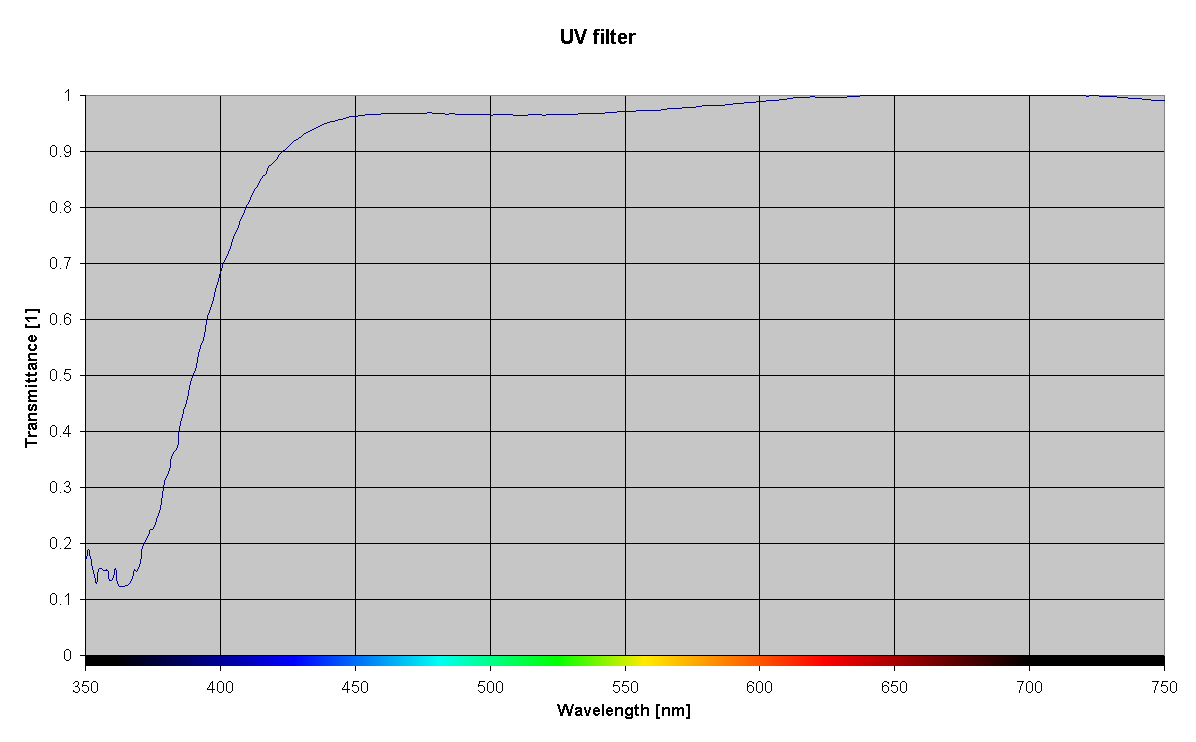
Raw measures of this filter between 350 nm and 2'500 nm are available here (CSV file, 37,860 bytes).
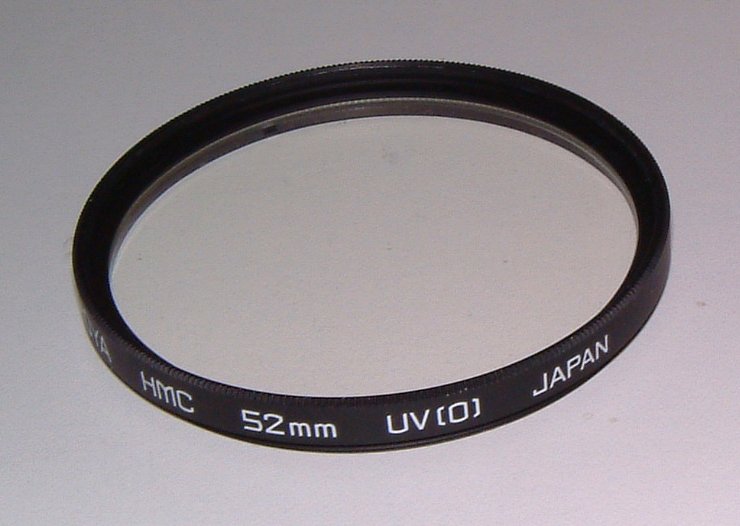
The measured filter here is a "HOYA HMC 52mm UV(0)". Just by looking at it, it has a clear aspect (not colored) indicating that it will probably let through all the visible light. The measurement shows a cut-off wavelength of 390 nm and an almost flat response in the visible part of the spectrum (let's say between 450 and 700 nm) corresponding to the expectations.
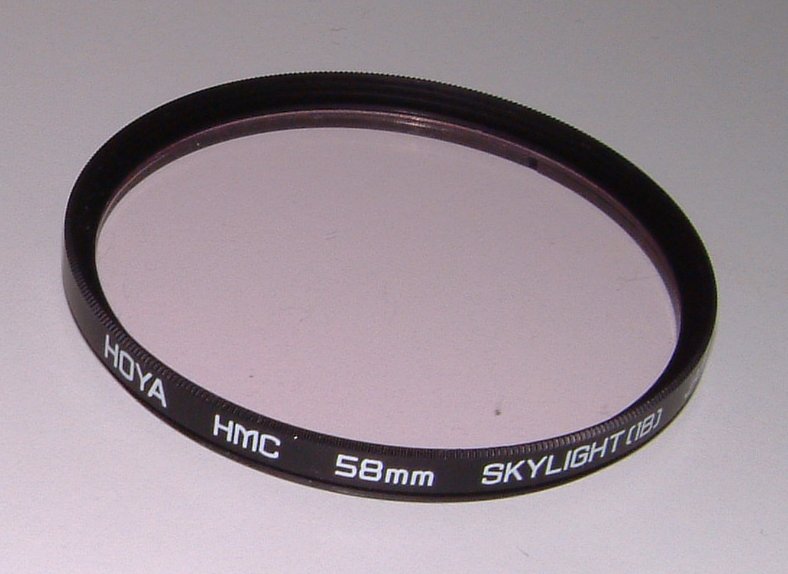
Skylight filters are similar to UV filters discussed above and are also generally used for lens protection, but instead of having a flat spectral response, they slightly attenuates blue. This is useful to reduce the blue color of the sky that is usually reflected almost everywhere in a landscape. Modern digital cameras do not require this feature anymore, since this can easily be obtained digitally after the picture has been taken.
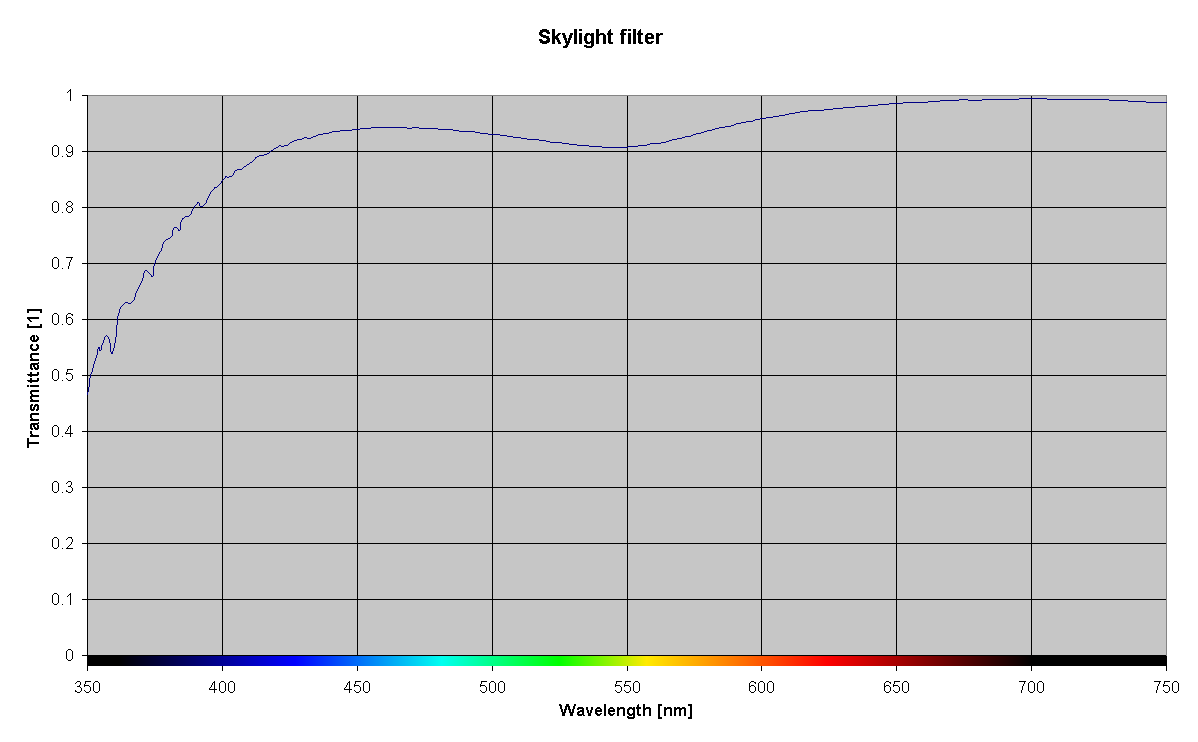
Raw measures of this filter between 350 nm and 2'500 nm are available here (CSV file, 37,882 bytes).
The filter measured here is a "HOYA HMC 58mm SKYLIGHT(18)". It appears slightly pinkish: so I expect a filter that attenuates blue a little bit and let red through. The measured spectrum corresponds to the expectations, but one can also see that this is a quite bad UV filter since UV light (wavelengths shorter than 400 nm) are not attenuated very much. The cut-off wavelength seems to be around 350 nm, which is typical for normal glass. On the other hand, nobody needs to attenuate UV with modern cameras.
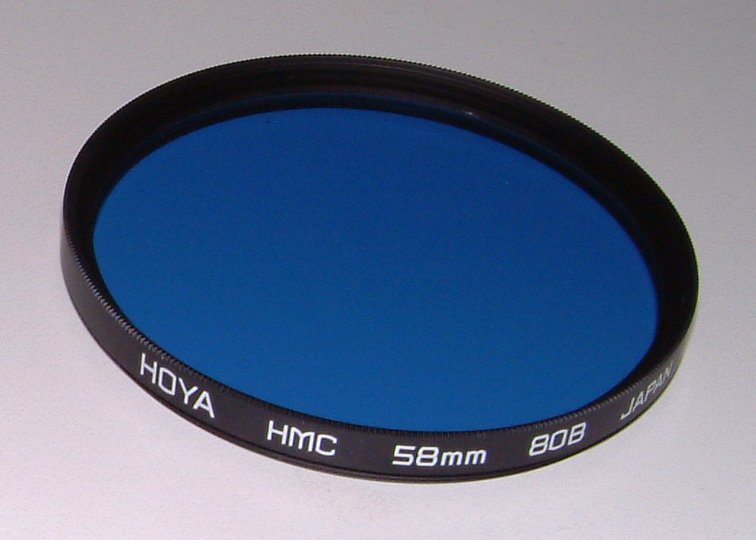
The 80B filter, as all filters in the 80 series, is used to increase color temperature (in other words, keep the blue and remove red). This particular filter will make the yellowish light produced by tungsten lamps appear white on daylight optimized films. The 80B filter is designed to increase the color temperature from 3'400 K to 5'500 K.
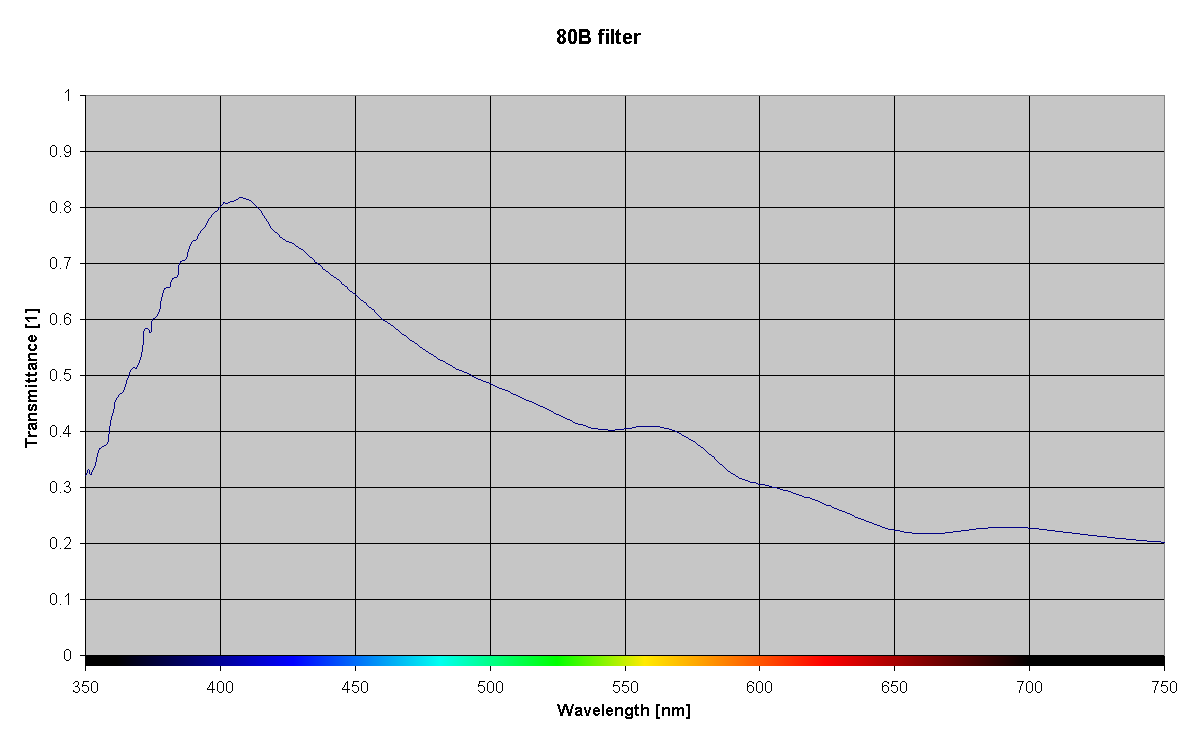
Raw measures of this filter between 350 nm and 2'500 nm are available here (CSV file, 37,866 bytes).
The filter measured here is a "HOYA HMC 58mm 80B" and appears blue because of its attenuation of red light. Since tungsten lamps produce maximum radiation in the red region, this will make the overall spectrum more uniform and the light will look whiter. The measured spectrum has a peak around 410 nm and than transmission decreases gently to about 20% in the red region. Of course this will reduce the overall amount of light available for the picture and the exposure time or the aperture usually need to be increased by 1-1/3 stops.
Changing the color temperature can easily be done on a digital image, so this kind of filters is of little use with a digital camera.
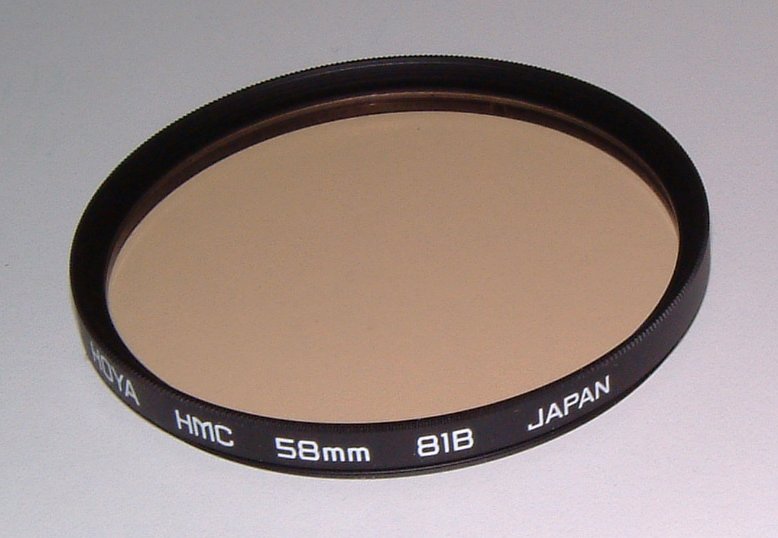
The 81B filter, as all filters in the 81 series, is used to decrease the color temperature (in other words remove blue and keep the red). The 81B filter is designed to decrease it from 3'500 K to 3'200 K.
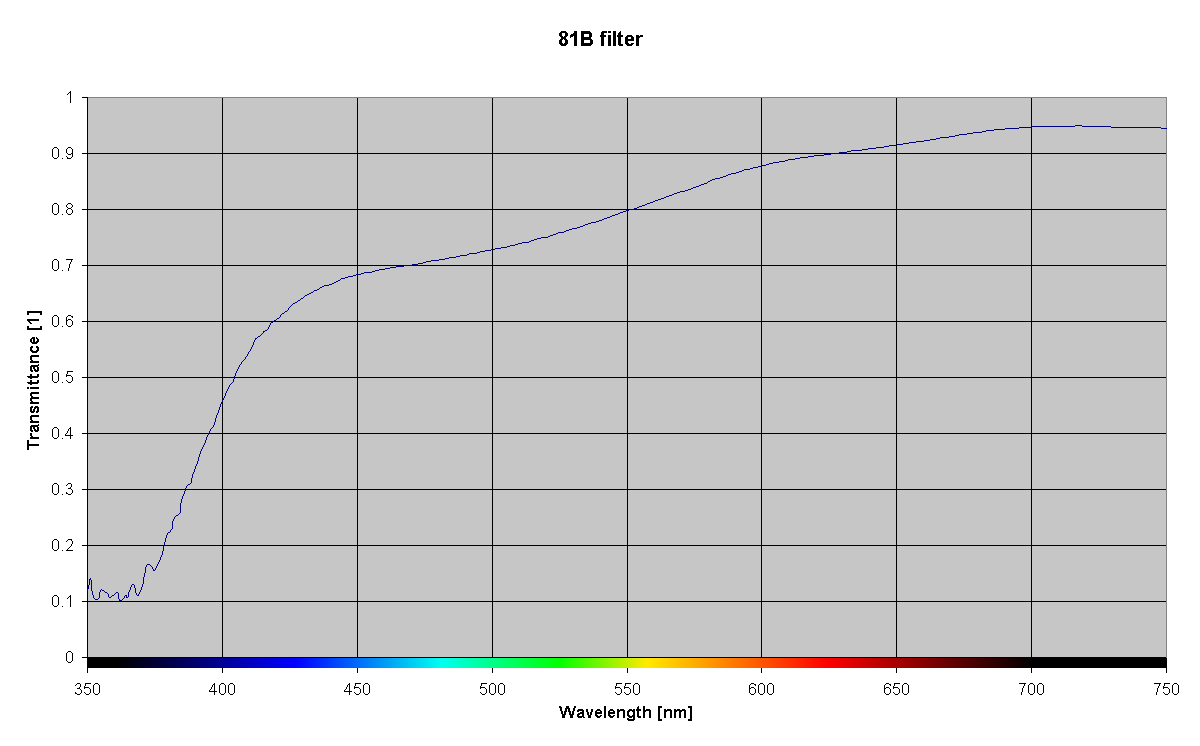
Raw measures of this filter between 350 nm and 2'500 nm are available here (CSV file, 37,835 bytes).
This filter measured here is a "HOYA HMC 58mm 81B". It appears orange because of its attenuation of blue light. Of course this will reduce the overall amount of light available for the picture and the exposure time or the aperture usually need to be increased by 1/3 stops. The measure below shows that this filter is also a good UV filter since radiation of shorter wavelength than 404 nm is cut off. Blue light is only transmitted at about 70% while red can go through almost completely.
Changing the color temperature can easily be done on a digital image, so this kind of filters is of little use with a digital camera.
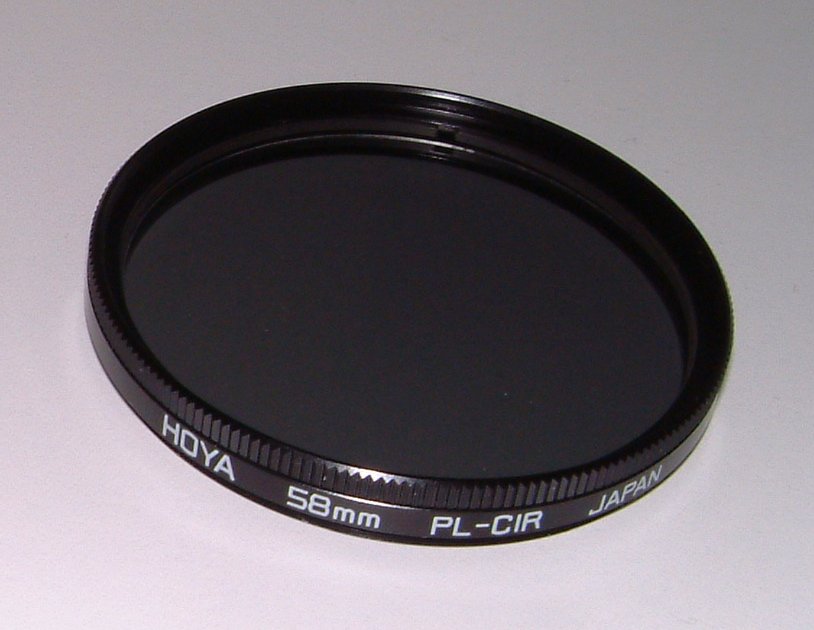
Circular polarizing filters are used for their ability of removing reflections that are usually composed of partially polarized light. Measuring the spectrum of such a filter will not produce any information about its polarization; it will only tell if the filter is neutral or attenuates any particular color.
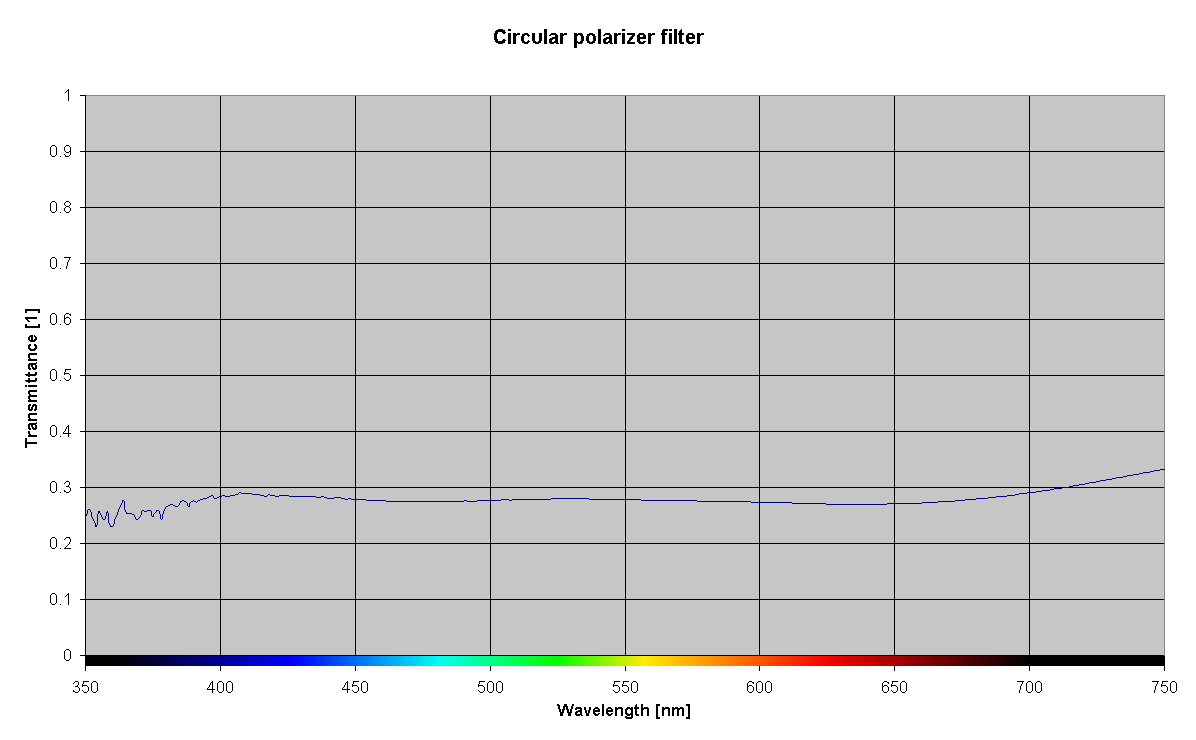
Raw measures of this filter between 350 nm and 2'500 nm are available here (CSV file, 37,853 bytes).
The filter measured here is a "HOYA 58mm PL-CIR". It has a very good neutral (flat) response in the visible spectrum (between 400 and 700 nm) and for this reason it appears grey. On the other hand, losses in the filter are very important. But this is normal in polarizers, since theoretically at least 50% of the non polarized incident light is blocked by the polarizing effect.
| Home | Optics | Page hits: 046127 | Created: 01.2004 | Last update: 12.2013 |