This page summarizes the basic characteristics of sensitivity of the human eye. This is useful when converting light intensities from luminous units like Lumens (lm) that take into account eye perception into radiometric units like Watts (W) that only take into account physical aspects.
A light source radiating 1 W of green light will appear much brighter than another source radiating the same amount of power of red light because the eye is more sensitive in the green region. The human eye is sensible to light wave which wavelength is roughly between 400 nm (violet) and 700 nm (red). Wavelengths shorter than 400 nm (ultraviolet, UV) or longer than 700 nm (infrared, IR) are not visible.
The eye behaves differently in high or low light conditions: in daylight, for brightness levels above 3 cd/m2 the vision is mainly done by the centre of the retina, we can see colors and the maximum sensitivity is at 555 nm (in the green region). This type of vision is called photopic vision.
In low light conditions, for brightness levels below 30 μcd/m2, the vision is mainly done by the peripheral region of the retina which is color-blind, while the centre region is not sensitive enough to see any color. This type of vision is called scotopic vision. Maximum sensitivity is at 507 nm (in the blue-green region) and red light is almost invisible.
The vision in-between photopic and scotopic vision is called mesopic.
The nice thing about scotopic vision and its reduced sensitivity to red light is that you can use a red flashlight to illuminate an object (to read a map, for example) without disturbing your nigh vision. It takes several minutes to get your vision used to the darkness; if you used a white flashlight instead, the eyes will switch back to photopic vision and you'll have to wait a few minutes again. Red light can directly be picked up by the centre of the retina without affecting night vision. For this reason, astronomers often use red flashlights.
The standard eye response is visible in the two figures below in both linear and logarithmic scale.
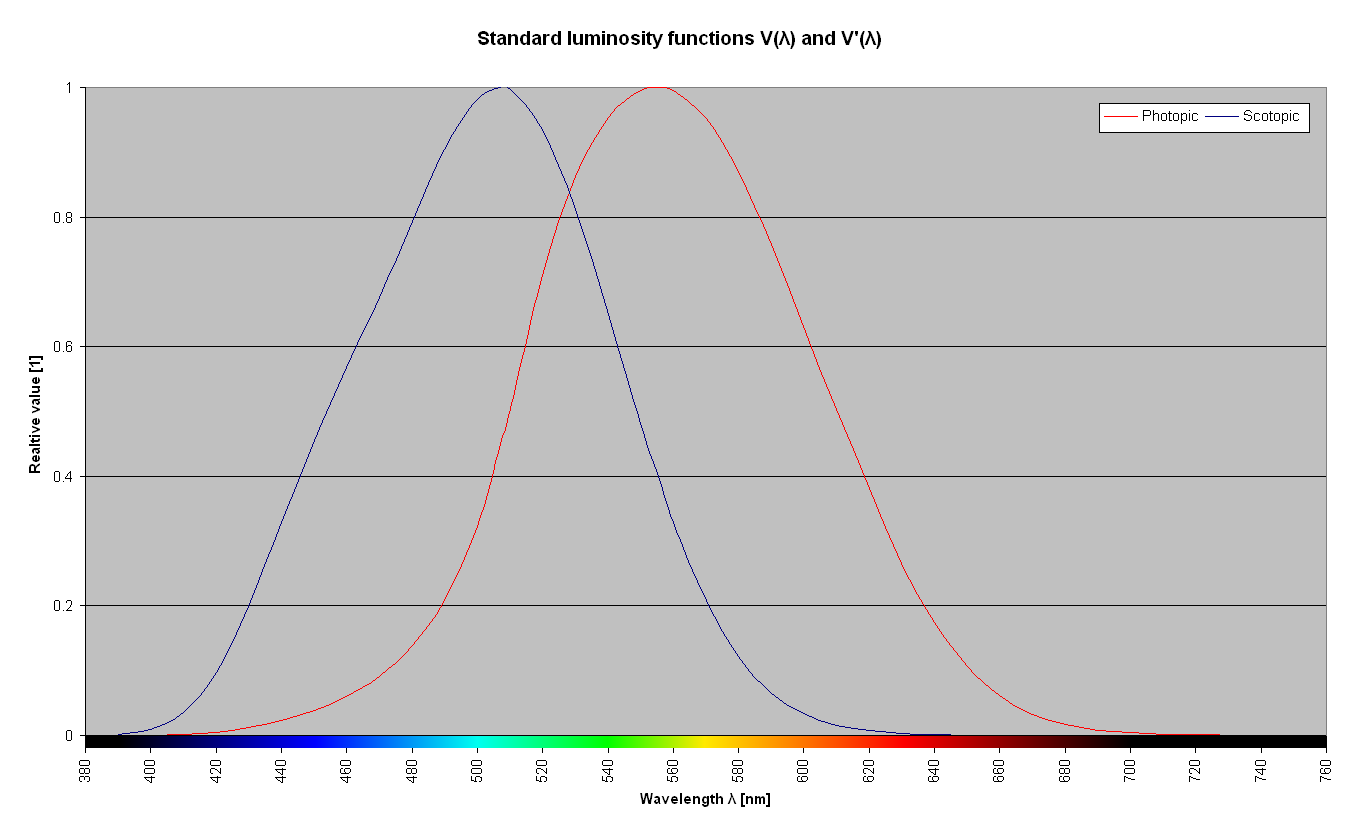

This standard eye sensitivity is also called standard luminosity function V(λ) and is used, for photopic vision, to define a conversion between the radiated energy (in Watts) and the luminous flux (in Lumen). The standard luminosity function V'(λ) refers to scotopic vision, but it shouldn't be used to convert to and from photometric units. A tabulated form of the two standard luminosity functions V(λ) and V'(λ) are represented hereafter:
| Wavelength λ [nm] |
Relative sensitivity [1] |
Equivalent of 1 W radiant power [lm/W] |
||
| Photopic V(λ) |
Scotopic V'(λ) |
Photopic I0·V(λ) |
Scotopic I0'·V'(λ) |
|
| 390 | 0.0001 | 0.0022 | 0.0683 | 3.74 |
| 400 | 0.0004 | 0.0093 | 0.273 | 15.8 |
| 410 | 0.0012 | 0.0348 | 0.820 | 59.2 |
| 420 | 0.0040 | 0.0966 | 2.73 | 164 |
| 430 | 0.0116 | 0.1998 | 7.92 | 340 |
| 440 | 0.0230 | 0.3281 | 15.7 | 558 |
| 450 | 0.0380 | 0.4550 | 26.0 | 774 |
| 460 | 0.0600 | 0.5672 | 41.0 | 964 |
| 470 | 0.0910 | 0.6756 | 62.2 | 1149 |
| 480 | 0.1390 | 0.7930 | 95.0 | 1348 |
| 490 | 0.2080 | 0.9043 | 142 | 1537 |
| 500 | 0.3230 | 0.9817 | 221 | 1669 |
| 507 | 0.4490 | 1.0000 | 307 | 1700 |
| 510 | 0.5030 | 0.9966 | 344 | 1694 |
| 520 | 0.7100 | 0.9352 | 485 | 1590 |
| 530 | 0.8620 | 0.8110 | 589 | 1379 |
| 540 | 0.9540 | 0.6497 | 652 | 1104 |
| 550 | 0.9950 | 0.4808 | 680 | 817 |
| 555 | 1.0000 | 0.4048 | 683 | 688 |
| 560 | 0.9950 | 0.3288 | 680 | 559 |
| 570 | 0.9520 | 0.2076 | 650 | 353 |
| 580 | 0.8700 | 0.1212 | 594 | 206 |
| 590 | 0.7570 | 0.0655 | 517 | 111 |
| 600 | 0.6310 | 0.0332 | 431 | 56.4 |
| 610 | 0.5030 | 0.0159 | 344 | 27.0 |
| 620 | 0.3810 | 0.0074 | 260 | 12.6 |
| 630 | 0.2650 | 0.0033 | 181 | 5.61 |
| 640 | 0.1750 | 0.0015 | 120 | 2.55 |
| 650 | 0.1070 | 0.0007 | 73.1 | 1.19 |
| 660 | 0.0610 | 0.0003 | 41.7 | 0.510 |
| 670 | 0.0320 | 0.0001 | 21.9 | 0.170 |
| 680 | 0.0170 | 0.0001 | 11.7 | 0.170 |
| 690 | 0.0082 | 5.60 | ||
| 700 | 0.0041 | 2.80 | ||
| 710 | 0.0021 | 1.43 | ||
| 720 | 0.00105 | 0.717 | ||
| 730 | 0.0005 | 0.342 | ||
| 740 | 0.00025 | 0.171 | ||
| 750 | 0.0001 | 0.0683 | ||
| 760 | 0.00006 | 0.0410 | ||
For photopic vision, 1 W of radiant power at the wavelength of 555 nm is defined to correspond to a luminous flux of 683 lm. For scotopic vision, the sensitivity of the eye is greater and 1 W of radiant power at 507 nm corresponds to a luminous flux of 1700 lm. These to wavelengths correspond to the maximum of each curve. Of, course, every eye is different; these data correspond to the standard eye, as defined by the CIE 1931 (photopic) and CIE 1951 (scotopic) standards.
| [1] | Warren J. Smith. Modern Optical Engineering - The Design of Optical Systems. 3rd Edition, McGraw-Hill, 2000, section 5.3. |
| [2] | Richard P. Feynman, Robert B. Leighton and Matthew Sands. Lectures on Physics. The Definitive Edition, Volume I, Addison–Wesley, 2006, chapters 35 and 36. |
| Home | Optics | Page hits: 087522 | Created: 01.2004 | Last update: 12.2013 |