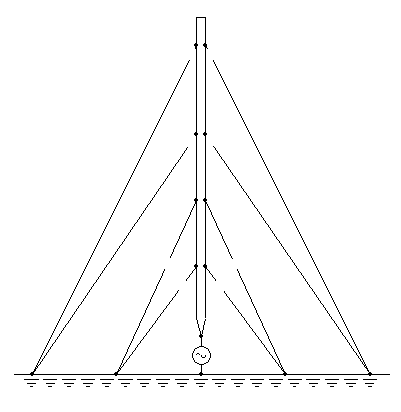
In order to get a rough idea of the performance of such antenna, it has been simulated and the gain, the radiation pattern, the antenna impedance and the current distribution has been calculated. Precise data about the structure are not available and the dimensions have been estimated via observations on site. No antenna performance data is available and therefore the result of the simulation cannot be checked against the reality and may be considerably wrong, but the figures look plausible and are reported and commented below.
The main antenna of the Monte Ceneri Cima transmitter is a thin tower 220 m high. Its base is insulated from ground and connected to the feeder via a matching network. The mast is hold in place by three groups of 4 guy cables. All guys are grounded on the lower end and insulated from the tower with an insulator that is placed almost against the tower (longest guys) or some way down (shortest guys). Transmission frequency is 558 kHz, one wavelength is 538 m and a quarter wavelength is 134.4 m.
Ground conductivity has a very big influence on the gain (the higher the conductivity the higher the gain), the elevation angle (the higher the conductivity the lower the angle) and the impedance. Unfortunately no information about ground conductivity is available. Since this antenna has buried radials to increase ground conductivity, a value of 10 mS/m has been arbitrary chosen.
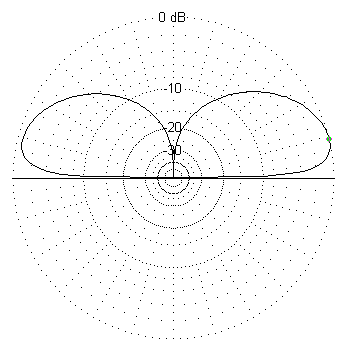
The simulation shows a gain of 1.6 dBd (including losses), an elevation angle of 14° and a half power beam-width of 34°. A very low radiation angle is important for long distance broadcast. The radiation pattern also shows no side lobes at high angles, meaning reduced fading in the reception, which is a very important feature of a broadcast antenna. The antenna is almost omni-directional in the horizontal plane; the guy wires only slightly modify the pattern by making the gain 0.5 dB higher in the direction of the guys.
The current distribution on the mast is similar to a λ/2 dipole. The maximum current is 50 A at about 90 m above ground. The feed impedance is (307.5 + j133.5) Ω, meaning that for a power of 300 kW, the feed current is about 31 A and the feed voltage is 10.4 kV. To have a comparison, 300 kW on a 50Ω resistive load require a voltage of 3.9 kV and a current of 77.5 A.
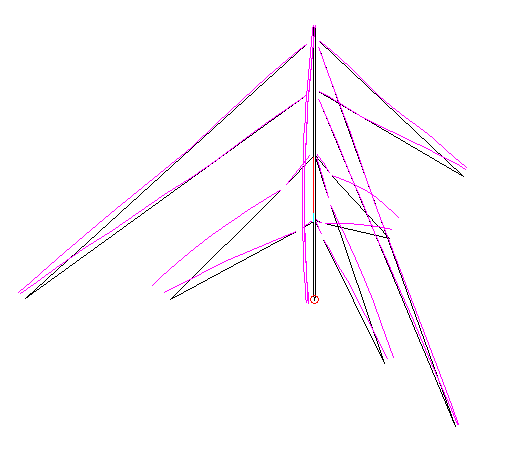
The simulation shows that a significant current flow in the guy wires, its maximum is in the second shortest guy wires at the ground connection where the current is about 18 A (per wire), but its influence on the antenna performance is small. The antenna has also been simulated without guy wires: the gain is slightly higher (1.9 dBd), the elevation angle stays the same (14°) and the half power beam-width a little smaller (32°). The feed impedance, on the other hand, is considerably different (544.2 + j269.2) Ω changing feed voltage and current to 14.3 kV and 23.5 A for the same power. The current distribution on the mast is similar, but this time the maximum current is 58 A at about 96 m above ground.